Quick Answer
A peptide is a molecular format, not a benefit claim. The value comes from the exact molecule, target, dose form, route, evidence, and product quality.
What This Helps You Do
- Separate structure claims from clinical claims.
- Ask whether the peptide has a defined receptor, enzyme, hormone pathway, or antimicrobial target.
- Compare the evidence tier before comparing products.
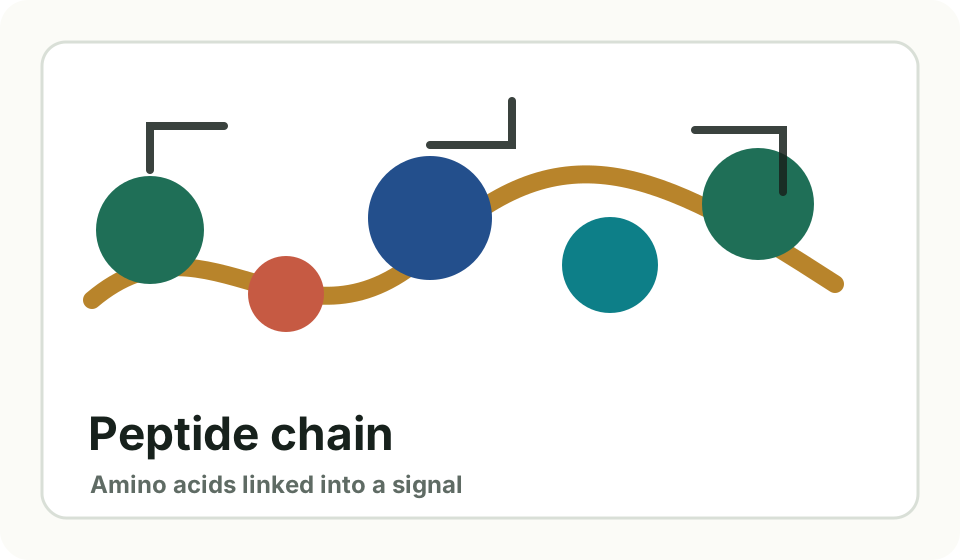
Peptides are short chains of amino acids joined by peptide bonds. The body uses many peptides as signals, including hormones and local messengers. That means the word describes a chemical structure, not a single outcome.
A useful way to read peptide claims is to ask what receptor or pathway is involved. Insulin, oxytocin, semaglutide, and eptifibatide are all peptide or peptide-like medicines, but they act in very different systems.
This is why broad promises such as recovery, anti-aging, or fat loss are weak on their own. The molecule, dose form, route, clinical indication, and evidence base matter more than the category name.
The useful definition
A peptide is easiest to understand as a message made from amino acids. Some messages are tiny and local, while others behave like hormones that travel through the bloodstream. Proteins are also amino-acid chains, but they are usually longer, more folded, and structurally more complex.
That distinction matters because peptide marketing often treats the word as a promise. It is not. A peptide can lower glucose, trigger uterine contraction, block clotting, affect appetite, or do nothing useful in humans depending on its structure and target.
How to read a claim
Start with the target. Does the peptide bind a known receptor, replace a deficient hormone, block an enzyme, or act as an antimicrobial? A claim that names a pathway is stronger than one that only says recovery, vitality, or anti-aging.
Then ask whether the claim is based on cell studies, animal studies, small human trials, or an approved product label. Those are very different evidence tiers.
Why route matters
Many peptides are fragile. Digestive enzymes can break them down, which is why many approved peptide medicines are injected, infused, implanted, or otherwise formulated carefully.
A peptide in a capsule, serum, vial, nasal spray, or implant is not automatically equivalent. The product design determines whether the molecule reaches the place where it can act.
Red Flags
- The pitch says peptide as if it guarantees anti-aging, recovery, or fat loss.
- No one can name the exact molecule, route, or human evidence.
- A supplement, cosmetic, research vial, and prescription drug are treated as interchangeable.
Questions To Ask
- What is the exact peptide or analog?
- What human outcome has actually been studied?
- How is the molecule supposed to reach its target?
Source Checkpoints
Use these official or clinical references to verify the category, claim, or safety concern before acting on marketing copy.